The ALMA-CRISTAL survey: Resolved kinematic studies of main sequence star-forming galaxies at 4 < z < 6
Abstract
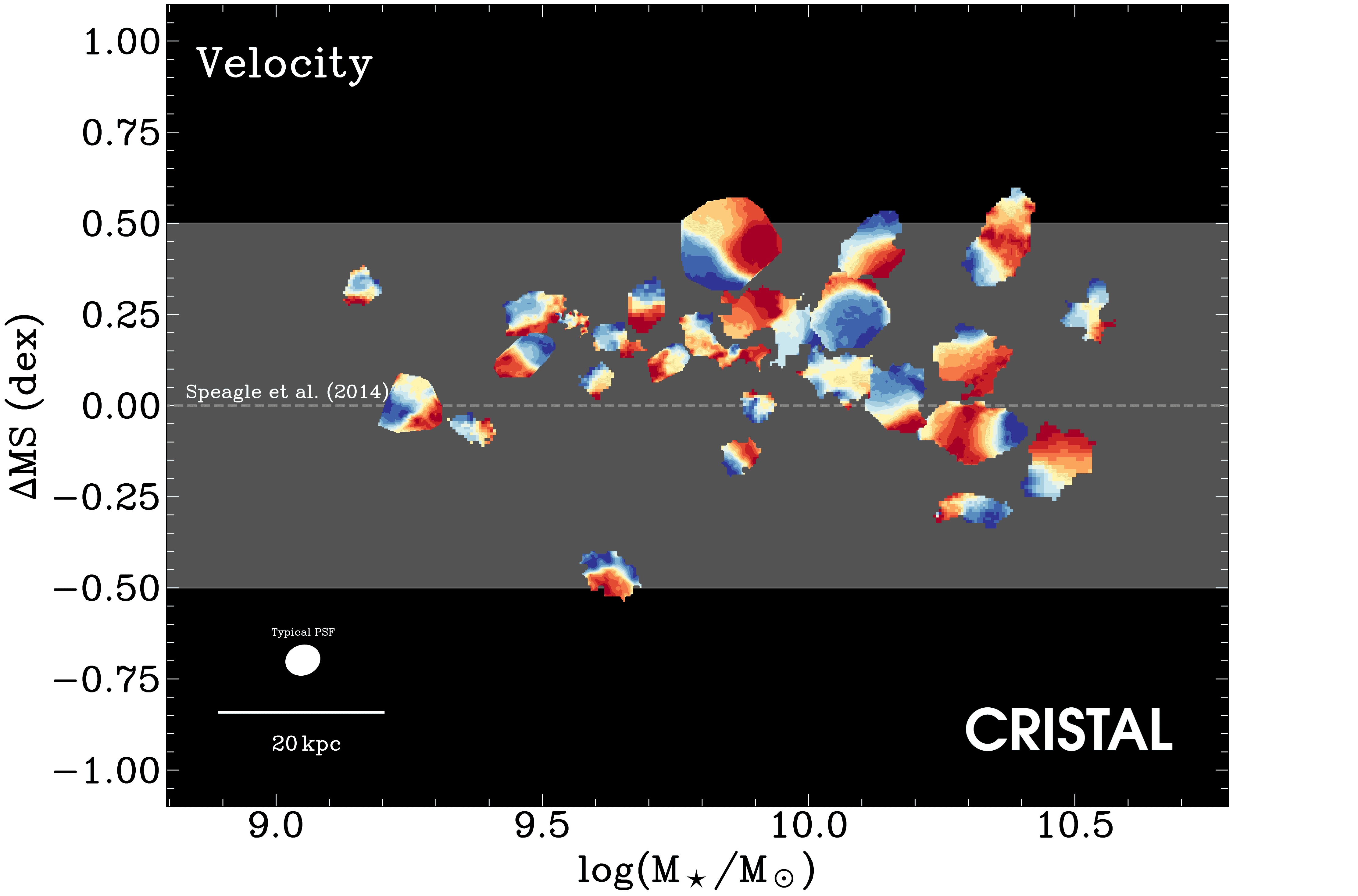
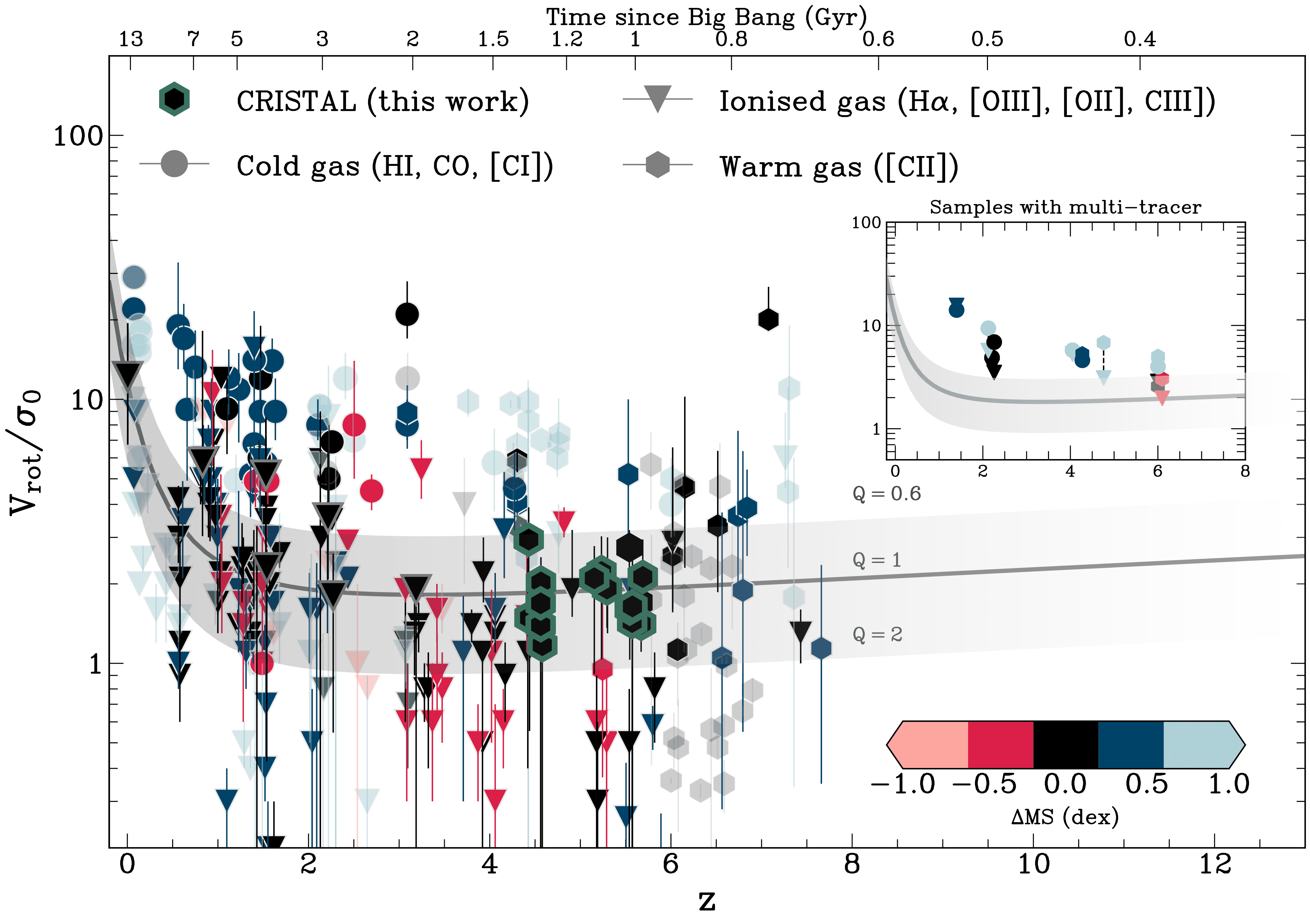
We present a detailed kinematic study of a sample of 32 massive (9.5 ⩽ log(M*/M⊙) ⩽ 10.9) main sequence star-forming galaxies (MS SFGs) at 4 < z < 6 from the ALMA-CRISTAL programme. The data consist of deep (up to 15 hr observing time per target), high-resolution (∼1 kpc) ALMA observations of [C II]158 μm line emission. This dataset allowed us to carry out the first systematic, kiloparsec-scale (kpc-scale) characterisation of the kinematics nature of typical massive SFGs at these epochs. We find that ∼50% of the sample are disk-like, with a number of galaxies located in systems of multiple components. Kinematic modelling reveals these main sequence disks exhibit high-velocity dispersions (σ0), with a median disk velocity dispersion of ∼70 km s‑1 and Vrot/σ0 ∼ 2, which is consistent with dominant gravity driving. The elevated disk dispersions are in line with the predicted evolution based on Toomre theory and the extrapolated trends from z ∼ 0–2.5 MS star-forming disks. The inferred dark matter (DM) mass fraction within the effective radius fDM(< Re) for the disk systems decreases with the central baryonic mass surface density. This is consistent with the trend reported by kinematic studies at z ≲ 3; roughly half the disks display fDM(< Re)≲ 30%. The CRISTAL sample of massive MS SFGs provides a reference of the kinematics of a representative population and extends the view onto typical galaxies beyond previous kpc-scale studies at z ≲ 3.
[Click here for the full article]
Key Figures